
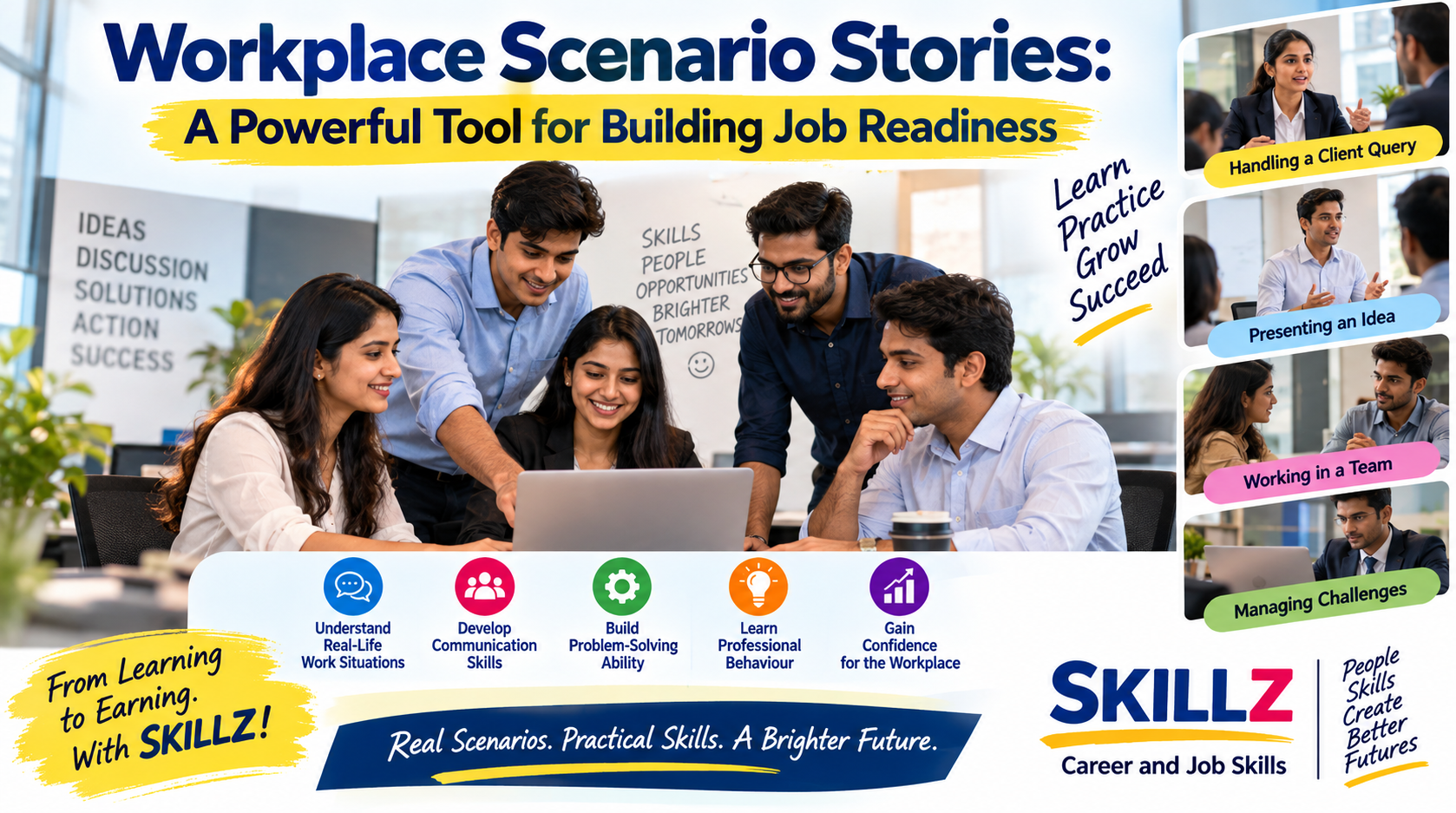
Workplace Scenario Stories turn the unwritten rules of office life into clear, learnable steps.
Imagine walking into your first job, or a completely new industry, where the unwritten rules of professional life feel invisible — where a simple email, a team meeting, or a piece of feedback becomes a source of anxiety. For many first-time job seekers, career switchers, and even neurodiverse professionals, this is a very real challenge.
But what if there was a simple, proven tool that could help people understand workplace situations, build new skills, and feel more confident on the job?
Enter Workplace Scenario Stories — a practical approach that's transforming how we prepare people for the world of work. And at SKILLZ, we've made scenario-based training a cornerstone of our job-readiness programs, with remarkable results.
What Are Workplace Scenario Stories?
Workplace Scenario Stories are short, personalized narratives that describe a workplace situation, skill, or expectation in a way that job seekers and new employees can clearly understand. Adapted from proven social-narrative techniques, these stories translate the unspoken norms of professional life into clear, concrete language.
The Power of Workplace Scenario Stories
- Provides visual and verbal learning — appeals to multiple learning styles
- Reduces anxiety — prepares people for new or challenging workplace situations
- Teaches perspective-taking — helps trainees understand a manager's or colleague's point of view
- Improves workplace understanding — makes the invisible visible
- Increases independence — empowers people with knowledge and strategies
- Builds confidence — creates positive associations with challenging situations
Who Can Benefit from Workplace Scenario Stories?
Primary Beneficiaries
First-Time Job Seekers
Fresh graduates entering the workforce, interns transitioning to full-time roles, and students preparing for internships.
Professionals in Transition
Career switchers moving into a new industry, returning-to-work professionals after a career break, employees moving into remote or hybrid work for the first time, neurodiverse professionals who benefit from explicit workplace guidance, and employees stepping into leadership roles for the first time.
Who Can Use Workplace Scenario Stories?
Everyone in a job seeker's support network:
Why Use Workplace Scenario Stories? The Proven Benefits
Improves Workplace Understanding
New employees often struggle to read office cues, understand unspoken norms, or predict what might happen next. Scenario Stories make the implicit explicit — turning a trainee who freezes at quick feedback into one who understands the process and responds professionally.
Increases Independence
By providing concrete information about what to do and when, Scenario Stories empower learners to navigate workplace situations without constant hand-holding.
Real result: learners report independently sending professional emails, joining meetings confidently, and handling deadline conversations after consistent scenario-story use.
Reduces Anxiety and Missteps
Workplace anxiety often stems from not knowing what to expect. Scenario Stories remove that uncertainty, easing the shift into new or unfamiliar situations.
A Positive Backdrop to Challenging Situations
Instead of only addressing problems after they occur, Scenario Stories proactively frame workplace situations positively — we don't just tell learners what NOT to do, we show them what TO do and why it matters.
A Learning Vehicle Across Environments
The beauty of Scenario Stories is their portability — the same story can be used in training, mock interviews, and on the actual job, so skills learned transfer across employers, roles, and industries.
Consistent use of scenario stories shows up in the numbers too:
- 80% reduction in interview-related anxiety when scenario stories are used consistently
- Significant decrease in miscommunication incidents in the first 90 days on the job
- Improved willingness to ask for help and try new tasks
When to Use Workplace Scenario Stories
To Acknowledge Positive Behaviors
Celebrate what a learner is already doing well — for example, "I Communicate Clearly with My Team" reinforces desired behaviors and builds self-esteem.
To Encourage Generalization
Help learners apply skills learned in training to real work settings — for example, "Following Up Professionally" carries over from mock interviews to real applications to client and vendor follow-ups.
To Explain Difficult or Confusing Situations
Make sense of situations that seem chaotic or unpredictable — for example, "What Happens During a Performance Review" explains the process step by step and provides reassurance.
To Correct Misinterpretations
Address situations a learner misunderstood — for example, "When My Manager Says 'Let's Circle Back'" clarifies workplace phrases and offers alternative responses.
To Prepare or Pre-Teach
Get ahead of potential challenges by preparing a learner in advance — for example, "My First Panel Interview" describes what will happen and offers coping strategies. Our Pre-Teaching Program creates custom stories for upcoming interviews, first days, or new responsibilities.
Where to Use Workplace Scenario Stories
Workplace Scenario Stories are incredibly versatile:
Job Search Stage
- Writing a cover letter
- Following up after an interview
- Negotiating a job offer
- Networking events and LinkedIn outreach
Onboarding & Early Career
- First-day introductions
- Understanding reporting structures
- Office or remote-work etiquette
- Asking for help without hesitation
- Managing your first deadline
Ongoing Professional Situations
- Team meetings and stand-ups
- Receiving constructive feedback
- Handling disagreements with colleagues
- Requesting leave or flexible work
- Client or customer interactions
Career Growth Moments
- Performance reviews
- Asking for a raise or promotion
- Leading or managing a team for the first time
- Handling layoffs or role changes
How to Write Effective Scenario Stories: The SKILLZ Method
The 6 Types of Sentences
Workplace Scenario Stories use six specific sentence types, each serving a unique purpose:
Descriptive — The Backbone
Answers who, what, when, where, and why, kept objective and factual.
"A stand-up meeting happens every morning at 9:30."
Perspective — The Heart
Builds empathy and understanding of a colleague's or manager's viewpoint.
"My manager feels reassured when I ask questions early."
Directive — The Action
Gently guides the learner toward appropriate responses, using "I can try" rather than "I must."
"I can try to arrive five minutes before the meeting starts."
Affirmative — The "It's OK"
Reassures the learner and validates shared, normal responses.
"It's okay to feel nervous before a big presentation."
Control — The "It's OK to Choose"
Written by or with the learner, giving them ownership of a coping strategy.
"When I feel unsure in a meeting, I can jot down my question and ask at the end."
Cooperative — The Helping Hands
Identifies who can help and how, reducing the feeling of being alone.
"My manager can help me if I'm unsure about a task."
10 Complete Workplace Scenario Story Examples
Starting My New Job
My First Day at WorkToday is my first day at a new company. My manager will introduce me to the team. New employees often feel excited and nervous on their first day — that's a normal feeling. I can try to smile and introduce myself with my name and role. If I forget someone's name, I can politely ask again. My HR contact will help me set up my accounts and access. Learning names and routines takes time.
Handling Feedback Well
Receiving Feedback from My ManagerSometimes my manager gives me feedback on my work. It's normal to feel a little uncomfortable hearing feedback — my manager wants me to succeed, so they share it to help me. I can try to listen fully before responding, and say "thank you, I'll work on that" even if it's hard to hear. If I don't understand the feedback, I can ask for an example. Using feedback well helps me grow faster in my career.
Writing Clear Work Emails
Sending a Professional EmailAt work, I often need to send emails. A good email has a clear subject line and a polite greeting — colleagues appreciate emails that get to the point. I can try to write one clear ask in each email and end with a polite closing. If I'm unsure how to phrase something, I can ask a colleague to review it. Clear emails save everyone time.
Sharing My Ideas in Meetings
Speaking Up in a MeetingMeetings are a time when the team discusses work together, and everyone's input is valuable. Sometimes I feel nervous about speaking up — that feeling is common, especially when starting a new job. I can try to prepare one point before the meeting starts and raise my hand or use the chat to ask to speak. If I miss my chance, I can follow up after the meeting.
It's Okay to Ask for Help
Asking for HelpSometimes I get stuck on a task at work. Everyone needs help sometimes, even experienced employees — my colleagues would rather I ask than struggle alone. I can try to explain exactly what I'm stuck on and ask, "Do you have a few minutes to help me with this?" Asking for help shows good judgment, not weakness.
Meeting My Deadlines
Managing a DeadlineAt work, tasks often come with a deadline, and meeting them helps my team plan their own work. It's okay to feel pressure around deadlines. I can try to break the task into smaller steps and check in early if I think I might be late. If I'm stuck, I can ask for an extension before the deadline, not after.
Talking to New People at Networking Events
Networking at an EventSometimes I attend events to meet new professional contacts. Networking events can feel busy and a little overwhelming — many people feel nervous about starting conversations, and that's completely normal. I can try to introduce myself with my name and what I do, and ask the other person about their work too. If I run out of things to say, I can ask an open question like "What brought you here today?"
When I Disagree with a Coworker
Handling a Disagreement with a ColleagueSometimes colleagues have different opinions about how to do something — disagreements at work are normal and can even lead to better ideas. My colleague also wants the project to succeed, even if their idea is different. I can try to explain my point calmly using facts and ask questions to understand their point of view. If we can't agree, I can suggest asking a manager for input.
Communicating Well While Working From Home
Working RemotelySometimes I work from home instead of the office. My team can't see me, so they rely on messages and calls to know what I'm doing, and my manager feels reassured when I share quick updates. I can try to update my status when I start and end work, and turn on my camera during video meetings when possible. Clear communication makes remote work run smoothly.
Talking to My Manager About Growth
Asking for a Raise or PromotionSometimes I want to talk to my manager about a raise or promotion — it's normal to feel nervous bringing this up. My manager wants to understand my goals and contributions. I can try to prepare examples of my achievements beforehand and ask for a specific time to have this conversation. If the answer isn't yes right away, I can ask what steps would help me get there.
Implementation: Making Scenario Stories Work
Best practices for using Workplace Scenario Stories:
- Timing is everything — introduce proactively, not reactively. Review before the situation occurs, during calm sessions, and regularly rather than just once.
- Repetition and consistency — review the story multiple times leading up to the situation, and keep reviewing even after success to reinforce the skill.
- Make it interactive — ask simple questions like "What would you say here?", role-play the scenario, or have them rewrite the story in their own words.
- Personalization is key — use the learner's actual job title and industry, real names where appropriate, and their own communication style.
- Portable formats — one-page printable cards, a digital version for pre-interview review, or an audio recording for auditory learners.
- Celebrate success — praise specific behaviors, review the story highlighting what went well, and create a follow-up story acknowledging the achievement.
Measuring Effectiveness: Does It Really Work?
Real SKILLZ program outcomes:
Common Mistakes to Avoid
- Don't write stories like rules. Avoid "I will NEVER be late" — instead, try "I can try to arrive a few minutes early. Being on time helps my team trust me."
- Don't make stories too long. Avoid a two-page story with 25 sentences — instead, aim for 8–12 sentences for most situations.
- Don't use stories as punishment. Avoid reviewing a story after a mistake as a consequence — instead, review proactively and calmly, not tied to incidents.
- Don't focus only on problems. Avoid stories only about what the learner does wrong — instead, balance teaching, acknowledging positives, and addressing challenges.
Take the First Step Today
Whether you're preparing for a first job, switching industries, or supporting someone who is, Workplace Scenario Stories turn the unwritten rules of work into something anyone can learn. Talk with one of our career coaches to build a set of scenario stories tailored to your goals — with no obligation.
You aren't unqualified, unmotivated, or incapable. You just need the unwritten rules of the workplace made visible. That's what Workplace Scenario Stories do — and it's what we help build at SKILLZ, every single day.
SKILLZ Career Solutions — Building stronger careers, one story at a time.